
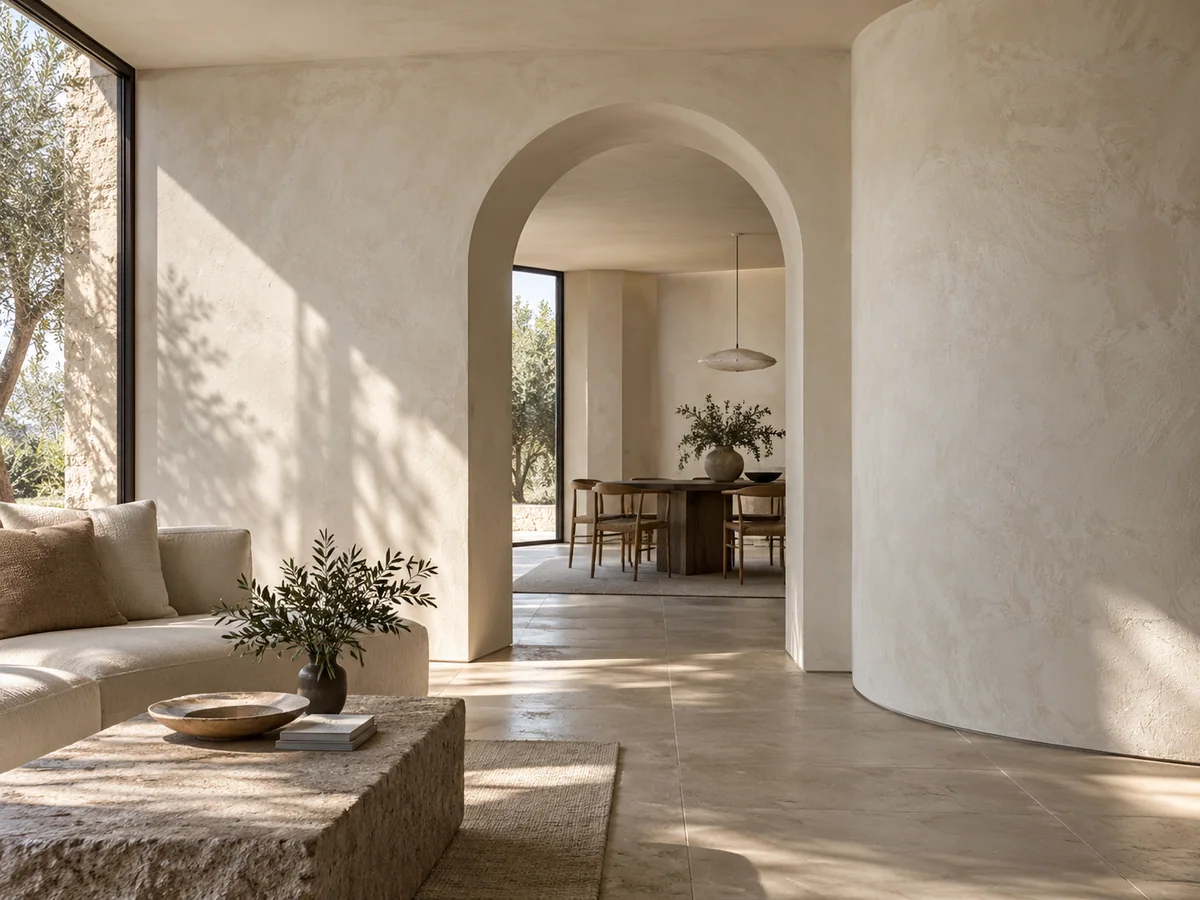
An arch has more surface than the front view suggests. There is the face around the opening, the inner return and the wall beyond it. Decide which of those will receive the decorative finish before the applicator prepares a sample.
For a curved wall, the same question follows you around the room: where does the finish begin, where does it end, and how should it look as the surface turns away from the light? Those choices give a hand-applied finish a clear role in the architecture.
If your search for decorative paint in Dubai has led you to plaster or mineral finishes, bring a drawing of the shape to the discussion. DecoPaint's Marmorino and Venetian plaster pages are useful starting points for the appearance. The specific product and preparation still need to be assessed for the proposed base and geometry.
First, draw the return
On an arch, the return is the surface inside the opening. Show its depth and the intended edge profile in a section drawing. A sharply defined edge gives a different outline from a softly rounded one; the reference photograph should make clear which you want.
Mark whether the finish wraps through the opening or stops at the front edge. If the far room has a different wall finish, choose exactly where that change occurs. The point may be visible from both sides, so check the reverse view as well as the main elevation.
For a curved partition, include its ends and the junction with the ceiling. A floor plan alone will not show how those edges are meant to look. Add any skirting, shadow gap or trim before the finish area is measured.
Let the base establish the shape
The contractor forming the wall and the specialist applying the decorative finish need an agreed handover condition. Ask who checks the curve, surface preparation and board or plaster junctions before the finish begins. Resolve visible irregularities at that stage.
Discuss cracks, changes of substrate and any areas that require specialist detailing. The chosen system's requirements should guide preparation. A decorative sample tells you about appearance; it does not confirm that the constructed base is ready.
A short trial of the difficult detail can be more useful than another flat colour board. For example, agree a representative section of the arch edge or a tight part of the curve for review. The purpose is to see whether the proposed finish and workmanship give you the outline you expect.
Watch the light travel across the curve
A curved surface presents several angles to the same light. Review the intended sheen with that in mind, particularly where a downlight or wall light sits close to it. Mark the fitting position on the drawing and view the trial from the approach to the room.
Consider the inside of the arch separately. It may receive less light than the face around it, and a finish selected for the brighter wall can appear different there. That difference might be welcome. Decide whether you want to retain it or adjust the finish selection after seeing the detail.
Keep the handwork intentional. Ask the applicator how the proposed texture will turn through the opening and how it will meet a flat adjoining wall. Avoid a brief that asks for a perfectly uniform result while using a highly varied reference image.
Fix the interruptions before application
A thermostat halfway around a curve, a wall-light cable at the arch edge or a shelf bracket in the return all interrupt the finished surface. Put those items on the drawing, including access panels that must remain usable.
Coordinate their positions with the relevant installer while adjustments are still possible. Where a fitting must be installed after the decorative work, agree the fixing method and protection with the team. If the shape forms part of a new partition, DecoPaint's role is the specialist finish; the wall construction and associated services belong with the responsible project trades.
Finish the brief with one marked elevation, the section through the return and your preferred material reference. Send those with photographs of the space when arranging a DecoPaint sample review. The team can then assess the surfaces you mean, including the edges that a front-on photograph leaves out.