
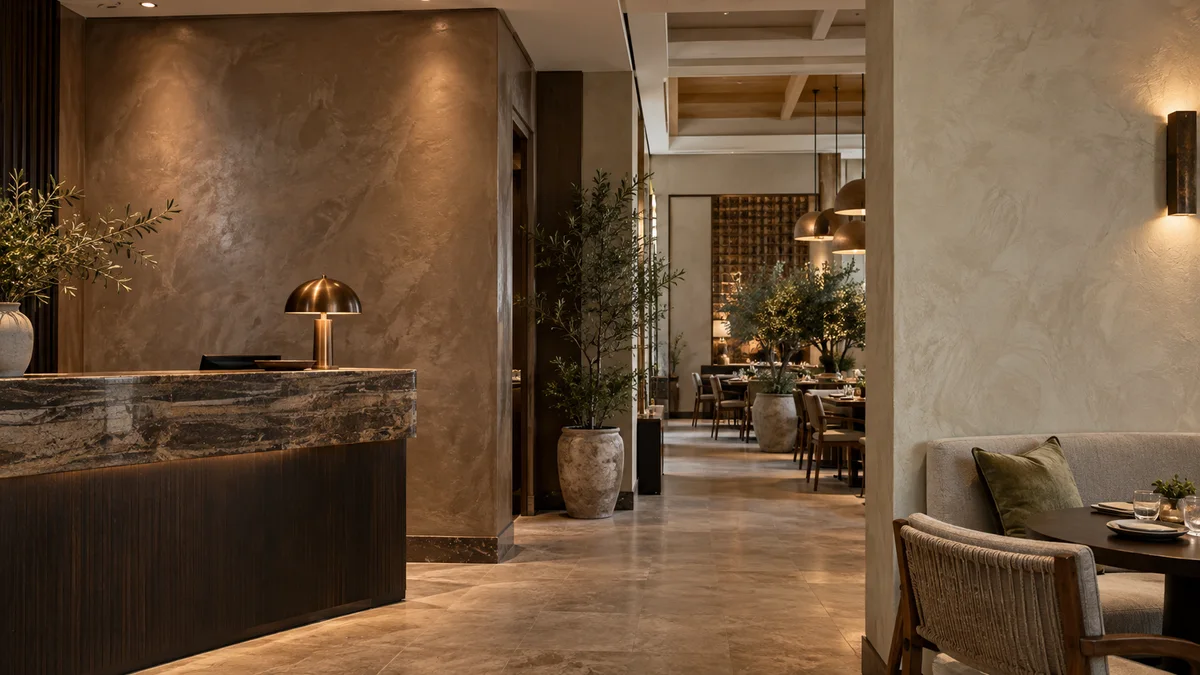
Decorative plaster can carry a hospitality interior with very little visual noise. It can also fail the brief if the same finish is carried from a quiet lobby wall into a splash zone, a chair-back route or a service corridor without reconsidering how that surface will be touched and cleaned.
Map the wall by exposure first. Then choose the plaster family, sheen and protection for each zone.
Give every wall an exposure class
A practical hospitality finish plan can use four simple classes:
| Zone | Typical conditions | Questions for the finish brief |
|---|---|---|
| Quiet visual surface | Reception backdrop, high lobby wall, private dining feature | What depth and sheen should the light reveal? |
| Regular touch | Corridor, lift lobby, wall beside banquettes or loose seating | Where will hands, bags and chair backs make contact? |
| Splash or stain risk | Bar return, host station, basin approach, food service edge | Can the surface tolerate the planned cleaning and protection system? |
| Wet or service zone | Shower wall, wash-up route, back-of-house circulation | Does this need a sealed wet-area or higher-duty finish instead of lime plaster? |
The categories make the finish schedule more honest. A single phrase such as "decorative plaster throughout" leaves the applicator to solve operational differences after colour has already been approved.
Choose the finish family by use
Marmorino combines lime and marble dust in a trowelled wall finish. It reads as soft polished stone and suits walls where controlled movement and sheen are part of the design.
Venetian plaster can take a more polished, luminous direction. It responds strongly to grazing light, so the intended lighting and the applicator's hand both belong in the approval process.
Limewash is brushed rather than trowelled. Its cloudy variation is useful where the design wants a softer, chalkier wall. DecoPaint's approved brand guidance is clear that lime-based wall finishes are not stain-proof. Keep them away from kitchen splash zones and other areas that receive aggressive cleaning.
For full-bond wet walls or locations that need a sealed continuous system, microcement is a different material conversation. The project team still needs to coordinate waterproofing, joints and cleaning, but it avoids asking a decorative lime plaster to perform outside its intended use.
Review the first metre above the floor
Hospitality walls often fail at human height. Luggage corners, dining chairs, cleaning equipment and hands all meet the lower section long before anyone studies the feature lighting above.
On elevation drawings, mark:
- chair and banquette backs;
- corners on guest circulation routes;
- luggage movement at rooms and lifts;
- wall-mounted menus, rails, screens and signage;
- service doors and trolley routes;
- splash lines near counters or basins.
The answer may be a different finish, a change in detailing, a protective element or a maintainable break line. Resolve it as part of the design. A clear junction usually looks more intentional than an invisible protection strategy added after the first damage appears.
Sample under operating light
A mineral wall changes through the day and again when hospitality lighting takes over. Downlights can exaggerate trowel marks. Grazing light can reveal every transition. Low, warm light may deepen a colour that looked neutral in the workshop.
Approve samples at the project whenever possible. Use the intended wall orientation and switch on the actual scene settings. Check the sample from the approach, the seated position and close range. The team should agree the preferred level of hand movement before the applicator starts, because words such as "subtle" and "cloudy" mean different things to different people.
The signed sample needs a reference code, colour, sheen, location and date. Photograph it in the space, but keep the physical board as the primary reference.
Build maintenance into the finish schedule
Ask the operator for the cleaning method in each zone. The finish specification should state what can be wiped, what needs a specialist repair and what must be protected from chemicals or abrasion.
Include a small close-out set for each finish:
- approved physical sample and mix reference;
- room and elevation schedule;
- cleaning and stain-response instructions;
- repair contact and a description of the expected repair appearance;
- record of retained material or colour reference, where applicable.
Mineral finishes contain natural variation. A local repair may remain visible under certain light, which is why planned boundaries and retained references matter.
Current Dubai hospitality context
On 13 September 2026, the Dubai Department of Economy and Tourism reported through the Dubai Media Office that several properties had begun extensive renovations. For teams working through those room, restaurant and public-area upgrades, the useful lesson is practical: agree the wall zones with operations before closing the decorative-finishes package.
Operational input does not flatten the design. It tells the designer where a delicate mineral surface will age well and where a different system will protect the original intent.
DecoPaint applicator note
Hand-trowelled finishes take their character from the sample and the applicator's technique. Give the applicator a marked-up elevation rather than a room name alone. Show the finish boundaries, lighting direction, touch zones and the intended level of movement.
For phased hospitality work, approve one controlled area before repeating the finish. Record who signs it off. The first completed wall becomes a clearer reference than a loose collection of phone images.
What to bring to a hospitality sample review
Bring the reflected ceiling plan, wall elevations, lighting scenes, nearby stone and timber samples, the operator's cleaning notes and photographs of the substrate. Identify which walls are quiet, touched, stain-prone or wet.
DecoPaint can then prepare the relevant Marmorino, Venetian plaster, limewash or microcement samples for the space. Book the review in the project light, where the finish has to work after opening.