
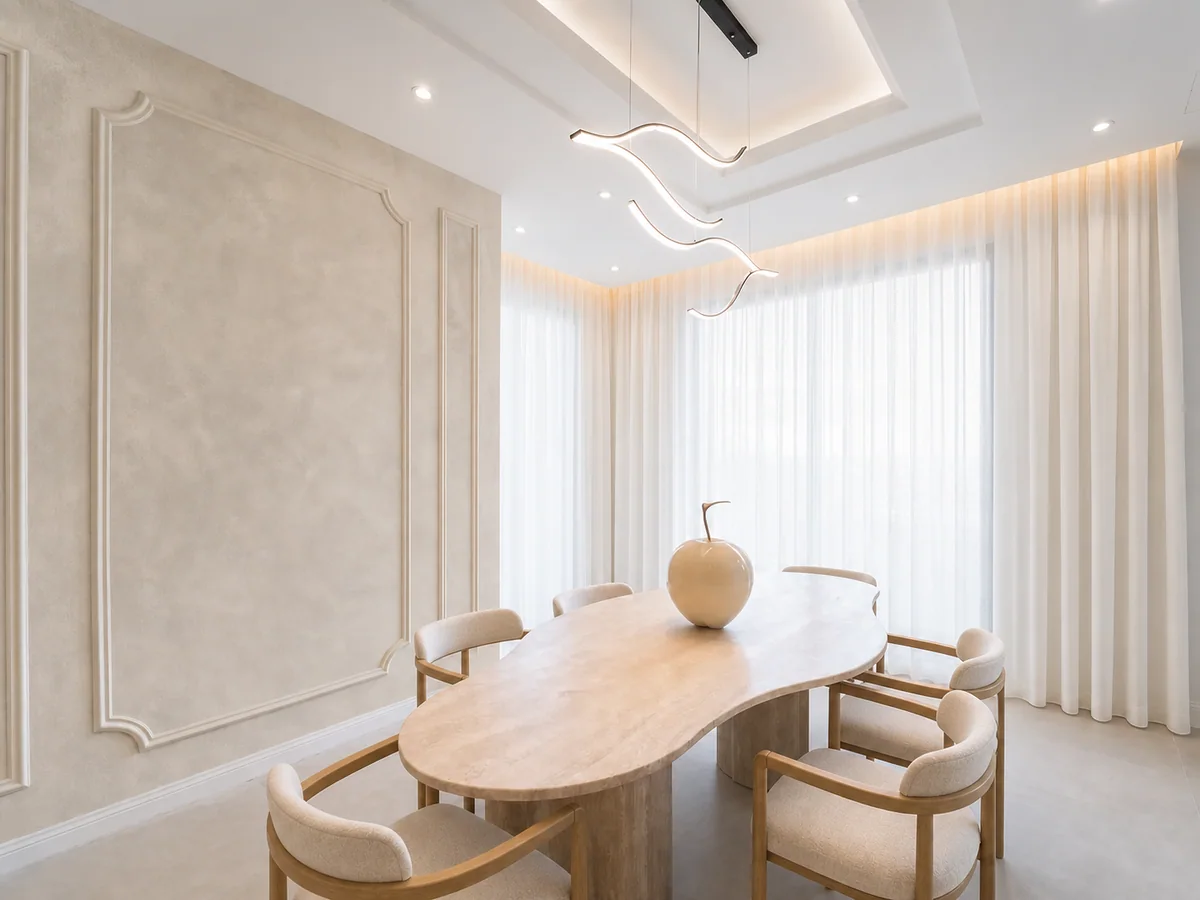
Most limewash enquiries reach us as a saved photograph and one question: can you do it, but even? We can’t, and after fifteen minutes at a sample board most people stop wanting it. The point of limewash is the cloudy movement that appears as brushed lime and pigment dry — lighter and darker passages where the brush journeys overlap. On the right wall that reads as depth. On the wrong wall it reads as a patch somebody meant to come back and fix.
So the first decision in a Dubai home, hospitality interior or retail space isn’t the shade. It’s whether this particular wall can carry a mineral finish that moves, and whether the people living with it will be relaxed about how it’s cleaned.
The short answer: good walls and poor candidates
| Choose limewash when… | Choose another finish when… |
|---|---|
| The wall is an interior feature wall and changing light is part of the design. | You need an even, uniform block of colour with no visible brush overlap. |
| The substrate can be assessed and prepared as an absorbent, sound surface. | The wall has unresolved damp, contamination or a substrate nobody has actually looked at. |
| You are comfortable with chalky tonal movement rather than a paint-film look. | The surface takes regular hard scrubbing, abrasion or splashes from a hob or sink. |
| You can approve a sample in the project’s own light. | The selection is being made from a phone screen or a swatch seen in a showroom. |
Limewash is a wall finish, and we keep it that way. Floors and full-bond wet-room walls are a microcement job — different material, different build, different warranty. If the brief includes a shower surround or a floor that takes trolleys and heels, start there instead of asking limewash to stretch. Explore DecoPaint limewash finishes.
Start with light, not colour names
A limewash colour is never one flat read. We mix pigment on site and test it under your daylight before committing, because the same wash reads two different ways at 10am and 6pm. A north-facing bedroom in Jumeirah and a west-facing living room that catches 4pm sun will not agree on what “warm greige” means, and no colour card settles that argument.
Which changes what a sample review is for. Bring the room to the wall, not a colour name:
- the floor finish, joinery sample and a key textile, if they’re chosen
- the wall as it actually is — daylight, and again with the evening lighting on
- where the sofa, bed or artwork lands, because a feature wall is always read against something
- an honest answer on how much movement you want: a quiet cloud, or a wall that clearly shows the hand
We tape samples upright on the wall itself for this reason. Flat on a table, limewash flatters — you lose the raking light that shows you what you’re actually buying.
Check the wall before you fall for the sample
Limewash forgives a lot, but not the wall underneath it. Ours goes onto plaster, lime render or primed gypsum; straight onto raw gypsum is risky, which is why the mineral-bond primer isn’t optional. The site visit exists to find out what’s really there — because “it’s just painted plasterboard” has turned out to be four layers of vinyl emulsion over a patched skim more than once.
Five questions worth settling at that visit:
- What is the existing substrate, and has it been painted, skimmed or patched?
- Does the wall need priming or a base preparation before the wash coats?
- Are there repairs, contamination or moisture marks to resolve first?
- Where does the finish stop — internal corner, reveal, shadow gap, or a join with another material?
- Is the batch being kept for touch-ups?
That last one saves grief later. We hold the original batch after handover, so a scuff at a light switch is a thirty-minute re-wash rather than a conversation about repainting the wall. Agree the intended character and the stop lines before we start; asking for a perfectly uniform limewash wall afterwards is asking for a different finish.
Where limewash stops earning its keep
It does its best work where a wall gets to stay a wall: a headboard wall, a living-room backdrop, a reception wall, a hallway, a calm hospitality interior. High-pH lime is genuinely hostile to mould and mildew, so humidity alone isn’t a reason to rule it out — plenty of our limewash sits in rooms that would trouble a paint film.
Staining is the real limit. Limewash isn’t stain-proof, so we keep it off the splash zone behind a hob or sink, and the handover instruction is a dry microfibre, or distilled water and a soft sponge for marks. Never a chemical cleaner, never an abrasive pad. That isn’t fragility — it’s a mineral surface, and it wants to be treated as one. Put the finish where those instructions are easy to follow and it will outlast the paint job it replaced.
If you want a mineral wall with a different read, the family is worth comparing before you commit:
- Limewash: brushed lime and pigment; soft, cloudy, chalky depth on walls.
- Marmorino: lime and marble dust, trowelled to a silk or polished-stone read; walls only. See Marmorino.
- Microcement: cementitious and seamless, built for floors and full-bond wet-room walls. See microcement.
Applying limewash through a Dubai July
July heat and humidity are a reason to plan the room, not a reason to postpone the finish. What matters is the air inside the space on the days we’re there: substrate condition, ventilation and whether the AC is running and stable. An outdoor forecast tells you very little about a closed villa interior at 24°C.
Be wary of drying times lifted from a foreign technical data sheet, too. Every lime system states its own conditions, and a rule written for a temperate climate and a different product doesn’t transfer to your wall. Ask the applicator who is actually doing the work what their system needs, on this substrate, in this room.
What it costs and how long the wall is out of use
Our limewash runs AED 180–280 per m², depending on coat build and pigment intensity. The wash is 2–3 coats: a loose first pass laying down colour with deliberate overlap, a tighter second building cloud where you want it, and an optional third for deeper colour or stronger movement. Plenty of our installs stop at coat two.
On site that’s about two days, then roughly five days of cure before the room goes back into normal use, and around fourteen days to full stability — mature lime doesn’t dust. Walls carry a five-year warranty. Worth knowing at the specification stage: the finish keeps reacting with the air for months, so it deepens rather than fades. See the limewash finish page for the full build, or how we work across Dubai if you’re scheduling around other trades.
Your sample-review checklist
Before booking a limewash sample review, have these ready:
- the exact wall or walls in scope
- photos of the wall in daylight and after dark
- anything nearby that splashes, gets touched or gets cleaned often
- the adjoining materials and their finished colours
- your call on quiet cloud versus visible hand-applied movement
- access for us to look at the substrate and the transitions
If limewash suits the wall, book a DecoPaint sample review. The win isn’t a faster colour decision. It’s a decision made in the room the wall has to live in.
FAQ
Is limewash suitable for every interior wall?
No. It’s most convincing where natural tonal movement is welcome and the wall isn’t scrubbed hard or splashed. Substrate condition needs checking before the system is chosen — that part isn’t negotiable.
Can I choose limewash from an online image?
Use online images to narrow the direction, never to approve the finish. We test pigment in the project’s own light because the same colour reads differently across the day and beside other materials.
How much does a limewash feature wall cost in Dubai?
AED 180–280 per m², set by coat build and pigment intensity, with a five-year warranty on walls. A later colour refresh is much cheaper — limewash brushes straight over itself with no stripping or sanding.
How long does limewash take to finish and cure?
Around two days on site for a typical feature wall, then about five days of cure before normal use, and roughly fourteen days to full stability. Those are our conditions and our system; don’t transfer them to another applicator’s product.
What should I read after this?
Once the finish is chosen, limewash care, retouch and refresh covers living with the wall — cleaning, hand-prints, and the seven-to-ten-year refresh. This article is only about whether limewash belongs on the wall in the first place.