
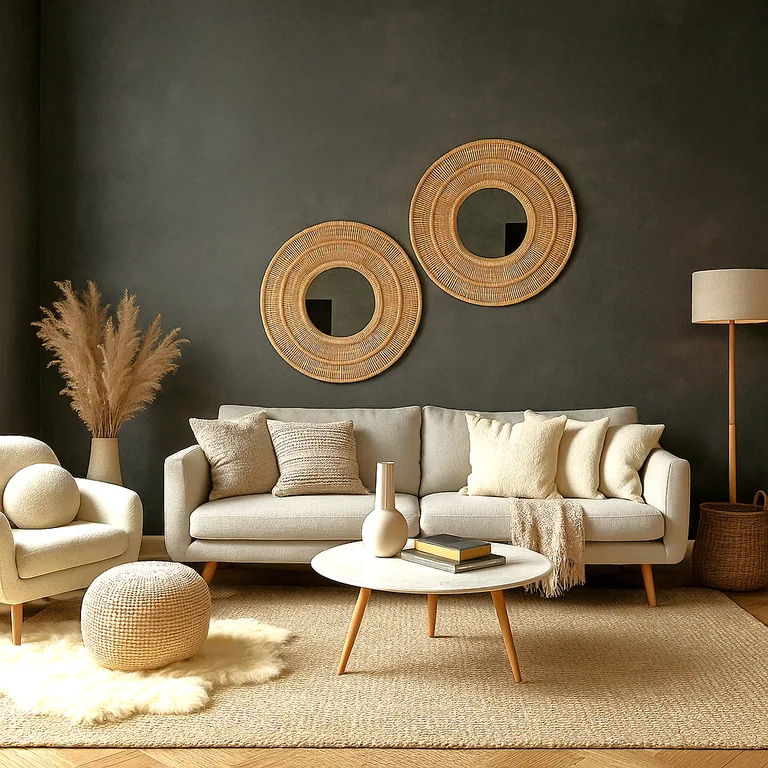
Limewash gives you a brushed, cloudy wall. Marmorino is a trowelled lime plaster with marble flour, and can be finished with a more pronounced sheen. If you are choosing between them for a living room, decide how you want the wall to respond to the room's light and furniture before settling on a colour.
They share a mineral character, but the marks left by a brush and a trowel do not read the same way. A photograph labelled “beige textured wall” can hide that difference. Put the two physical finishes beside one another and the choice becomes easier to discuss.
When you want the wall to stay soft
DecoPaint's limewash finish has the overlapping variation of a brushed application. That can suit a room where linen, timber and a few carefully chosen pieces already give you enough detail. The wall adds movement without introducing a polished surface.
Soft does not have to mean pale. A darker colour can still have that cloudy character. Decide how much variation you enjoy, especially behind framed artwork or open shelving where the wall becomes part of a more complicated composition.
Take a sample to the sofa position and then to the far end of the room. If the brushwork is the first thing you notice everywhere, try a quieter application. You are choosing the amount of movement as well as the pigment.
When a trowelled finish suits the room
Marmorino offers a different surface character, with trowel movement and a choice of sheen. It is worth considering when you want to see the finish change as you move past it, or when the room has a large uninterrupted wall that can carry that detail.
It need not be highly polished. Ask to see the available matte and satin treatments before deciding that Marmorino will be too reflective. Equally, do not choose a polished version from a photograph without checking how it looks beside your actual windows and fittings.
A room with a patterned stone table and strongly grained cabinetry may already have enough variation. In that setting, a restrained Marmorino application could be easier to live with than a sample chosen for its most dramatic marks. This is a design judgement to test with the room's materials, not a restriction on the finish.
Let the furniture settle the comparison
Place both samples upright behind the upholstery or timber sample you intend to use. Keep their colours reasonably close at first. Otherwise, you may simply choose your preferred colour and mistake that for a preference between materials.
Look during the day, then with the lamps you use in the evening. Move the boards to a wall beside the window as well as the one facing it. The change in viewing position is useful evidence: perhaps you prefer limewash behind the sofa but Marmorino on a separate wall where it catches the light.
You can use both, provided their boundaries make sense in the room. An inside corner or a defined wall plane gives the change a clear location. Draw that stopping point so the applicator does not have to resolve it during finishing.
Consider the parts people touch
Think about the wall beside a light switch, behind a movable dining chair or along the route where children carry bags. Discuss those areas with the applicator before assuming that one finish will suit every wall in an open living and dining room.
Care requirements belong in the selection meeting. DecoPaint's limewash care guide discusses cleaning and refreshing that surface. For Marmorino, request instructions for the actual finish and any protective treatment proposed. Neither the word “mineral” nor a smooth appearance is enough to tell you how aggressively a wall can be cleaned.
If the living room opens into a kitchen, identify splash areas separately. A successful choice behind a sofa does not automatically become the right finish beside the sink.
Book a side-by-side sample review with a photograph of the intended wall and the main upholstery reference. Describe whether you want a quiet background or visible handwork, and which lights will be on most often. Those observations give the applicator a clearer direction than a style label alone.